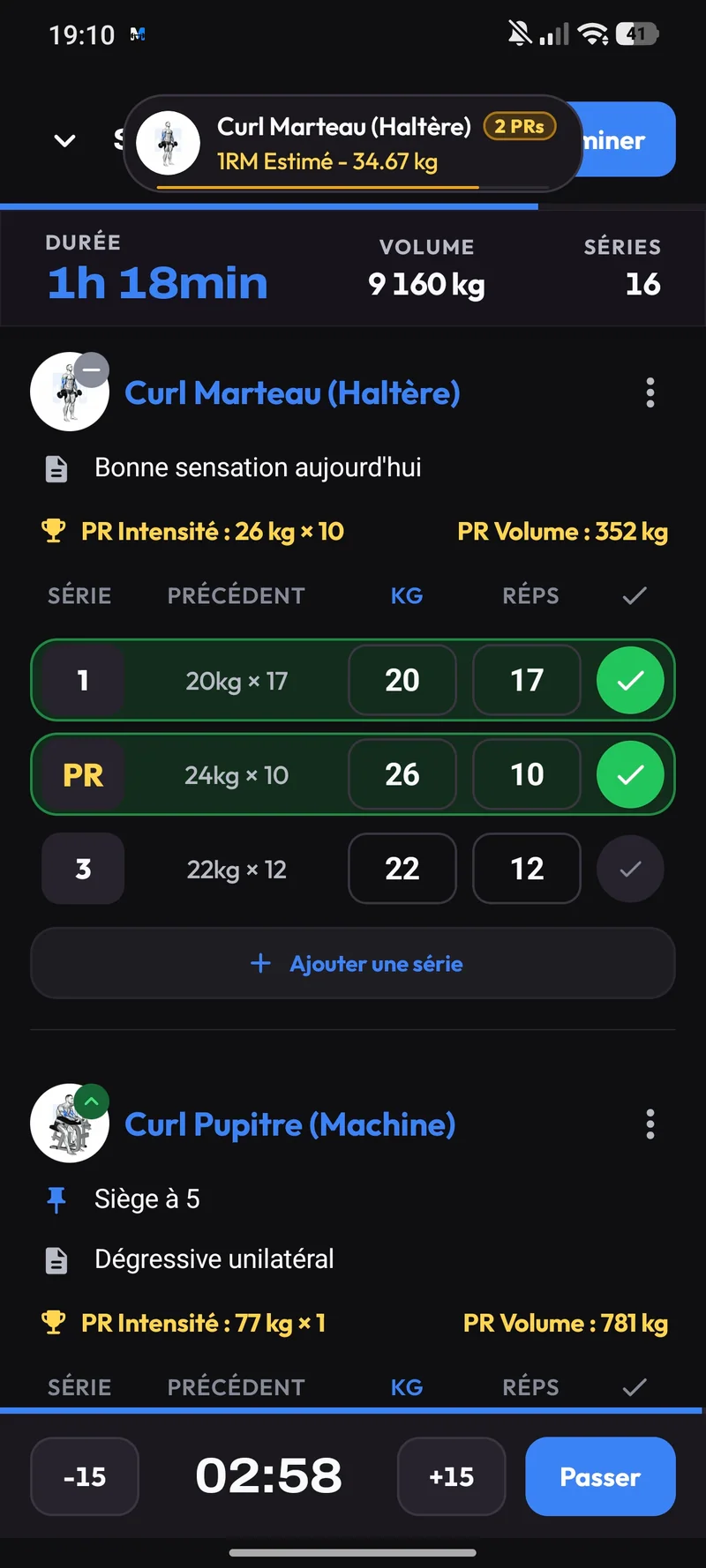

The bottom line before you train:
There is no secret to building muscle: you have to lift heavy and push for progression. If you breeze through exercises back-to-back without needing to catch your breath, you aren’t lifting heavy enough. Your muscle has already adapted to that load and has no reason to grow.
Keep the hierarchy simple: 1. Range of Motion (full, controlled reps), 2. Intensity (heavy loads close to failure), 3. Volume (weekly set count).
No Secret: You Have to Lift Heavy
People look for magic tricks in the gym, when the underlying rule is straightforward. To grow, a muscle must face tension harder than what it can already handle comfortably.
If you jump straight from one exercise to the next after 40 seconds without feeling taxed, the weight is too light. Your body is already used to it. Without a real challenge, it simply stays the same.
Follow these three priorities in strict order:
- 1. Range of Motion: perform every rep through a full, controlled stretch without cutting depth just to move bigger numbers.
- 2. Intensity: once your form is solid, lift heavy and push near failure, taking proper rest between sets so you can give maximum effort again.
- 3. Volume: only adjust total weekly sets after locking in range of motion and intensity. A handful of hard, full-ROM sets will always beat 25 easy ones.
With the practical rule clear, here is what peer-reviewed research shows for each piece.
1. Full Range of Motion & Stretch-Mediated Hypertrophy
- Pallarés et al. (2020): Full-depth squats beat half and quarter squats over 10 weeks for strength, hypertrophy, and lower joint discomfort (PubMed PMID: 31975157).
- Pedrosa et al. (2022): Training muscles at longer, stretched lengths yields significantly more muscle growth than shortened-range partials (PubMed PMID: 33977835).
- Wolf et al. (2023): Meta-analysis confirming a consistent hypertrophy advantage for Full ROM and lengthened-muscle training (PubMed PMID: 36598395).
2. Intensity, Progressive Overload & Proximity to Failure
As synthesized by Schoenfeld (2010) (PubMed PMID: 20847704), muscles adapt when mechanical demand exceeds prior exposure.
- Proximity to Failure / RIR (Robinson et al., 2024): Meta-regressions show hypertrophy scales as sets get closer to failure (0–2 reps in reserve). Stopping far shy of failure with comfortable weights produces a weak signal (PubMed PMID: 35291645).
- Load or Rep Progression (Plotkin et al., 2022): Both adding weight and squeezing out extra clean reps at a challenging load drive growth (PubMed PMID: 36199287).
3. Why Rushing Kills Intensity (ATP & Rest Intervals)
Heavy sets burn intramuscular ATP and Phosphocreatine (PCr). Replenishing 85%–95% of PCr takes 3 to 5 minutes.
- Schoenfeld et al. (2016): Lifters resting 3 minutes between sets gained significantly more strength and muscle thickness than those resting 1 minute (PubMed PMID: 26605807).
- de Salles et al. (2009): Confirms 3–5 minute rests preserve load and rep performance across sets (PubMed PMID: 19691365).
4. Volume: Only Effective When Sets Are Hard
- Schoenfeld, Ogborn & Krieger (2017): Meta-analysis showing dose-response muscle gains up to roughly 10–20 hard weekly sets per muscle group (PubMed PMID: 27433992).
5. Supporting Heavy Output: Creatine Monohydrate
- ISSN Position Stand (Kreider et al., 2017): Most effective ergogenic supplement for high-intensity work capacity and lean mass (PubMed PMID: 28615996).
- Rawson & Volek (2003): +8% strength and +14% more reps at a given load vs. placebo (PubMed PMID: 14636102).
- Burke et al. (2023): Direct imaging meta-analysis confirming enhanced upper and lower body hypertrophy (PubMed PMID: 37432300).
- Antonio et al. (2021): Safe for healthy kidneys, does not cause hair loss, and promotes intracellular muscle hydration (PubMed PMID: 33557850).